
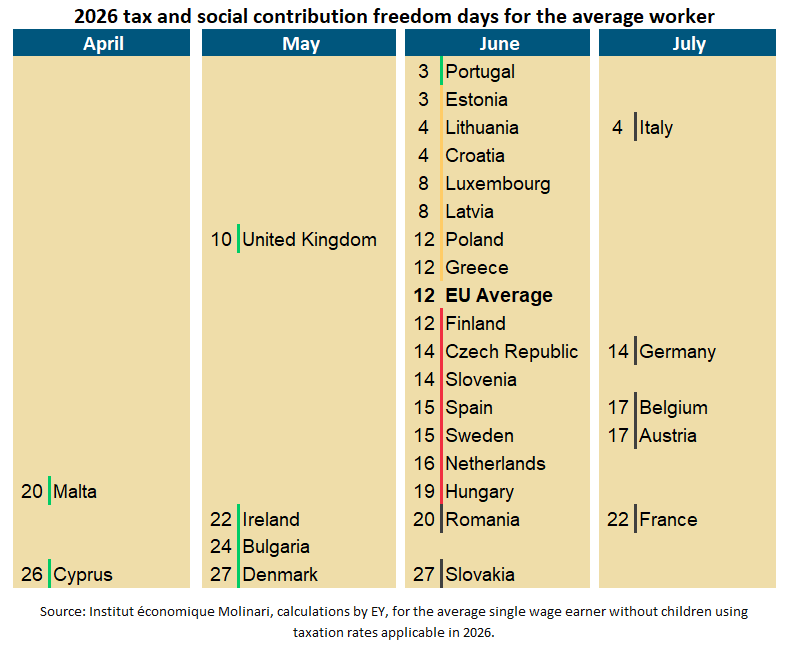
The average European employee worked until June 12th to finance public services and collective benefits in 2026. France, Austria and Belgium remain champions of compulsory taxation on the average wage earner
Paris, July 22, 2026 – Using data calculated by EY, the Institut économique Molinari is issuing its 17th annual study on the real social and fiscal pressures faced by the average wage earner in the European Union (EU).
This ranking has the distinct feature of providing figures for the current year on the social and fiscal pressure faced by the average worker, applying a solid, uniform methodology across all 27 EU member countries. It provides a firm understanding of the real impact of taxes and social contributions and the changes they are undergoing.
In the European Union as a whole
The pressure on average wage earners increased reaching Tax Freedom Day on June 12th, 2026, a whole day later than in 2025.
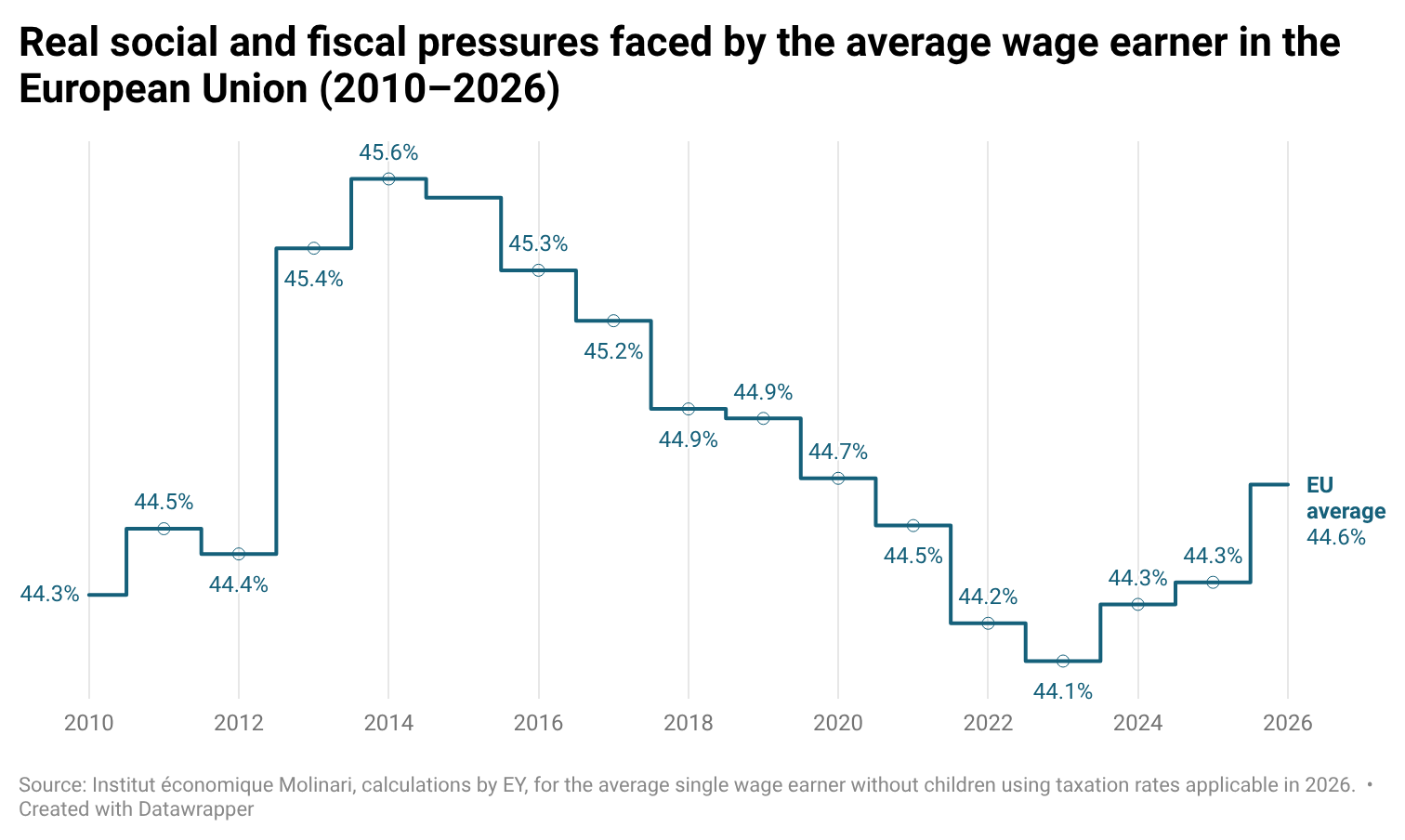
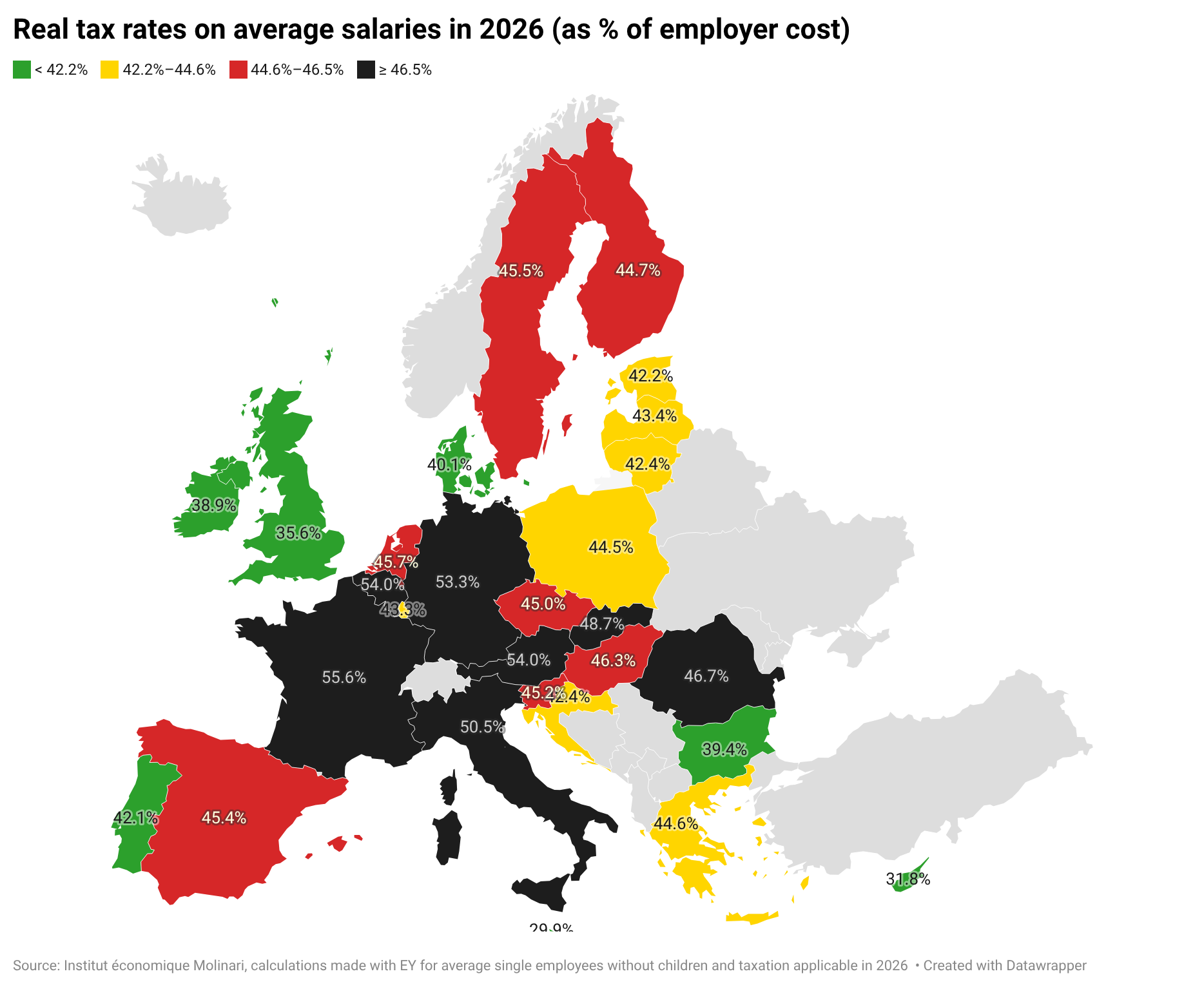
In 2026, the effective tax rate for employees is at 44.6% in the EU-27. It is up by 0.3 points compared with 2025 and by 0.5 points compared with the low point in 2023.
In concrete terms, an average employee generating €100 of income before tax and charges will have to pay €44.60 in compulsory deductions in 2026. Ultimately, they will have €55.40 of real purchasing power at their disposal.
France, Austria and Belgium in the top of countries that levy the most taxes on the average worker
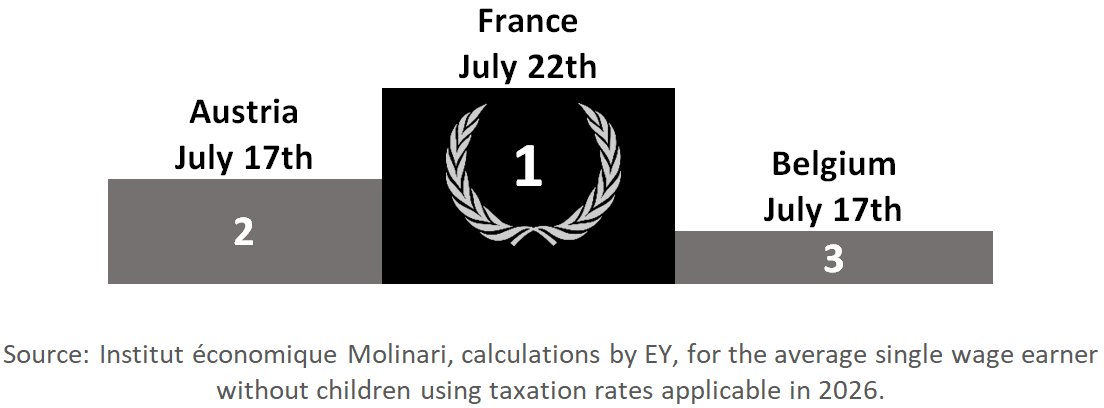
France is once again the EU’s champion for compulsory deductions in 2026, with social and fiscal liberation occurring only on July 22nd, four days later than in 2025. Until that date, the average single employee has no direct control over how the fruits of their labour are spent. France remains in the No. 1 position it held from 2016 to 2020 and since 2023. The tax burden on the average employee is 55.6%, up compared with last year (+1.20 point).
Austria is second on the podium, with its social and fiscal liberation coming on July 17th, three days later than in 2025. Taxation of the average wage earner stands at 54 per cent, up on last year (+0.6 point), resulting in a three-day delay in the tax and social security-free date. Taxation has risen due to the progressive nature of income tax: as gross wages have risen faster than the adjustment of tax brackets, income tax has increased more rapidly than incomes.
Belgium is third on the podium, with its social and fiscal liberation coming on July 17th, three hours before Austria. The tax burden on the average employee stands at 53.99 per cent, with Freedom Day occurring one day later than last year.
Germany comes in the 4th place, with social and fiscal liberation on July 14th with 53.3% taxation on the average employee.
Italy comes in 5th place on July 4th with 50.5% taxation on the average employee.
Over the past year
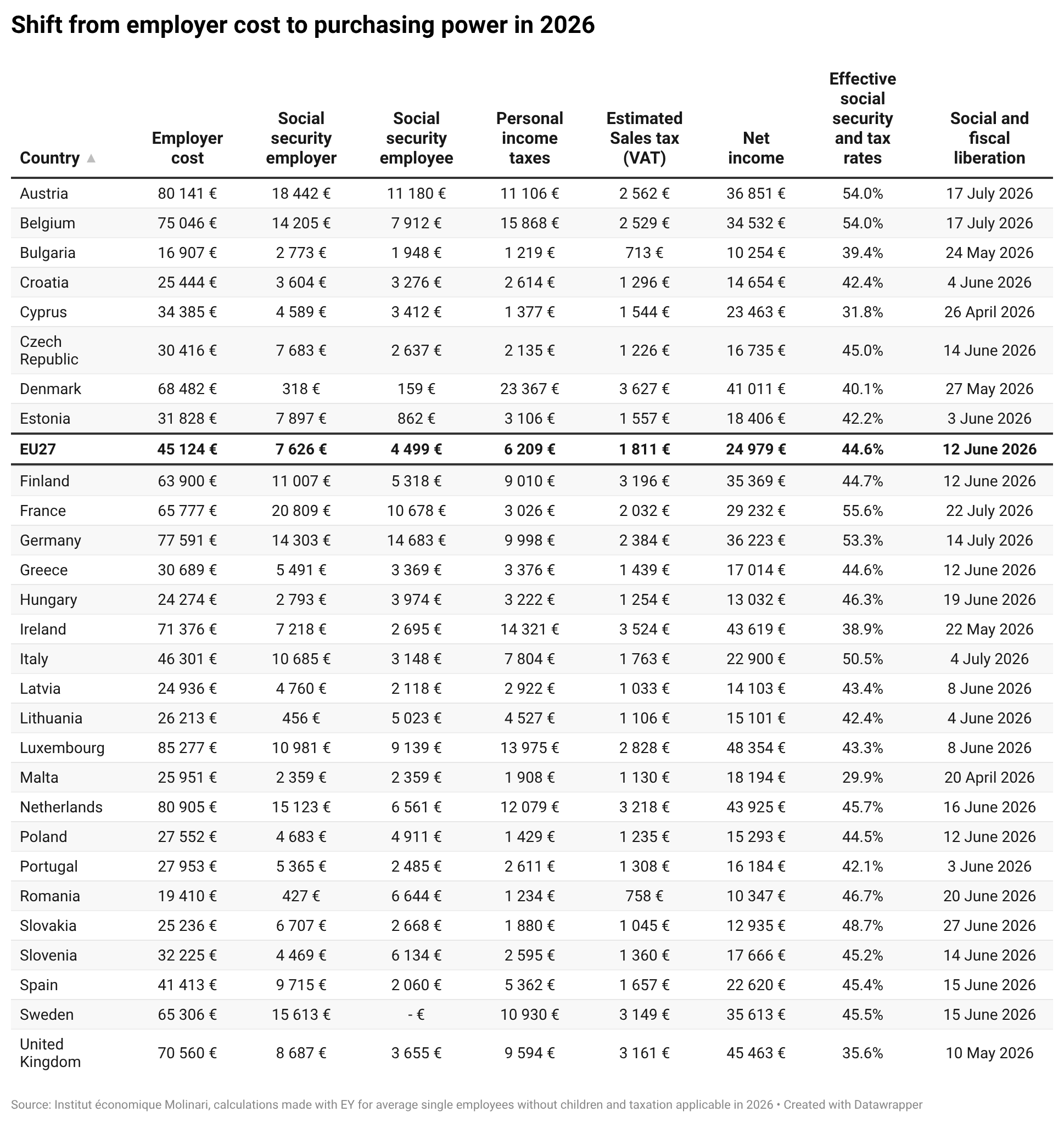
Seventeen EU countries have seen increases in compulsory levies leading to a loss of between one and six days of social and fiscal freedom: Belgium, Spain, Luxembourg, Romania, Slovenia and the Czech Republic (-1 day of tax and social security freedom), Cyprus, Estonia, Lithuania and Poland (-2 days), Austria, Croatia and Slovakia (-3 days), France and Italy (-4 days), Malta (-5 days), and Germany (-6 days).
Five countries remain stable: Bulgaria, Hungary, Ireland, Latvia and the Netherlands.
Five countries have recorded a decrease in levies, allowing them to recover days of tax and social security freedom: in Denmark (+1 day), Finland and Sweden (+2 days), Greece (+3 days) and Portugal (+4 days).
In 5 European countries, taxes and social security contributions are higher than disposable income
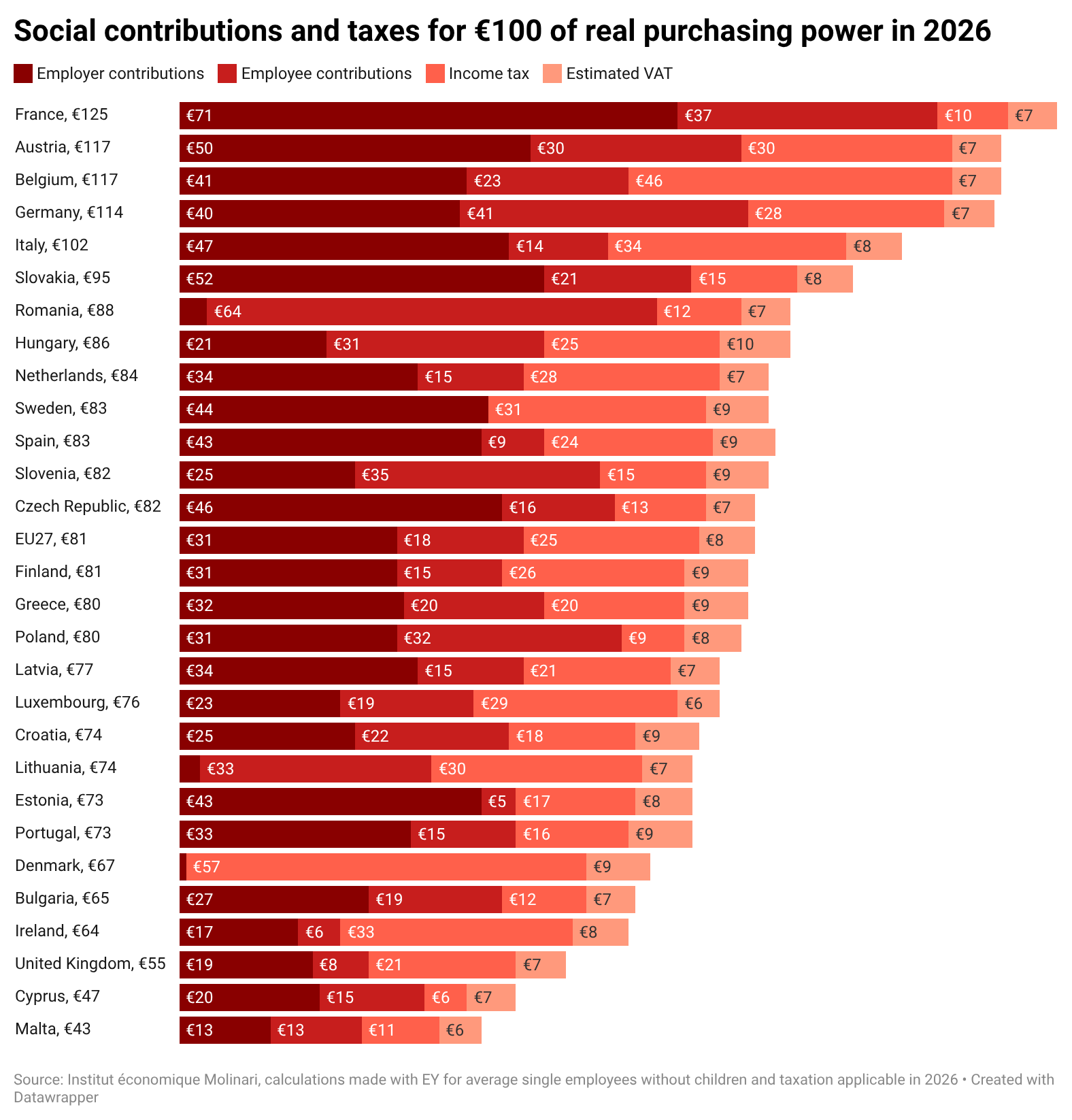
Before they achieve €100 of real purchasing power, the average French employee must first pay €125 in taxes and contributions, this compared with €117 in Austria and Belgium, €114 in Germany and €102 in Italy. The EU average is €81.
QUOTES
Cécile Philippe, president of the Institut économique Molinari, co-author
“In a number of key areas, the public is witnessing a deterioration in service levels, despite record levels of taxation.”
“To spend money wisely and protect taxpayers, one must have the courage to do a cost/benefit analysis. But we have lost the habit of taking this common-sense approach and correcting course when the value for money in collective services is inadequate.”
Nicolas Marques, general manager of the Institut économique Molinari, co-author
“Contrary to popular belief, high levels of social security contributions and taxes do not necessarily mean better public services.”
“This is particularly true when it comes to pensions. France, Austria, Belgium, Germany and Italy have only very small pension funds, with barely 7 to 30 per cent of GDP invested, depending on the country. This artificially inflates the cost of funding pensions and the social and tax burden on average workers.”
“It is no coincidence that average Danish, Swedish and Dutch workers are tax-free one to two months earlier: they have between 120 and 200 per cent of GDP invested to fund their pensions. This makes financing pensions less costly, increases the purchasing power of both working people and retirees, and reduces wealth inequalities by sharing added value even more widely.”
James Rogers, associate researcher at the Institut économique Molinari, co-author
“French, Austrian, Belgian, German and Italian wage earners are still devoting more than half of the amounts distributed by their employers to social contributions and taxes.
“It’s worth asking why they are not getting the top schools, the best health care and the most generous pensions in return.”
DATA SUMMARY
ABOUT THE TAX AND SOCIAL CONTRIBUTION FREEDOM DAY
The tax and social contribution Freedom Day is the date when the average employee stops, in theory, paying compulsory social contributions and taxes and can use the fruit of her labour as she pleases.
This indicator measures the date starting on which the employee becomes free to apply the fruits of her labour in the way she wishes and not the date starting on which the employee may stop “working for society.”
The particularity of this indicator of economic freedom is that it puts the situation of average EU wage earners in tangible form by bringing together each country’s taxation of labour (social contributions and income tax) and of consumption (VAT). Calculations of employer and employee social contributions and of income taxes are done by EY for each of the 27 EU countries.
RESOURCES
The study, La pression sociale et fiscale réelle sur le salaire moyen au sein de l’UE en 2026 (17ème édition) is available at the links below in French at: https://www.institutmolinari.org/wp-content/uploads/2026/07/etude-fardeau-fiscal-eu-2026.pdf
A Datawrapper map is available: Real tax rate for the average employee in 2026
https://www.datawrapper.de/_/bEVQC/
As well as 3 Datawrapper tables:
Real social and fiscal pressures faced by the average wage earner in the European Union (2010–2026): https://www.datawrapper.de/_/exkHz/
Social contributions and taxes for €100 of real purchasing power in 2026: https://www.datawrapper.de/_/FjHLb/
Shift from employer cost to purchasing power in 2026:
https://www.datawrapper.de/_/b9NXM/?v=2
ABOUT THE INSTITUT ÉCONOMIQUE MOLINARI
The study was written by Nicolas Marques, Cécile Philippe and James Rogers of the Institut économique Molinari (IEM).
The Institut économique Molinari (Paris and Brussels) is an independent research and education organisation. It seeks to stimulate the economic approach in the analysis of public policy, offering innovative alternative solutions that favour the prosperity of all individuals making up society.
FOR INFORMATION OR INTERVIEWS, PLEASE CONTACT THE AUTHORS
Cécile Philippe, President of the Institut économique Molinari (Paris, French or English), cecile@institutmolinari.org, +33 6 78 86 98 58
Nicolas Marques, General manager of the Institut économique Molinari (Paris, French),
nicolas@institutmolinari.org, +33 6 64 94 80 61
James Rogers, Associate researcher at the Institut économique Molinari (Brussels, English),
james@institutmolinari.org, +32 497 946 840